
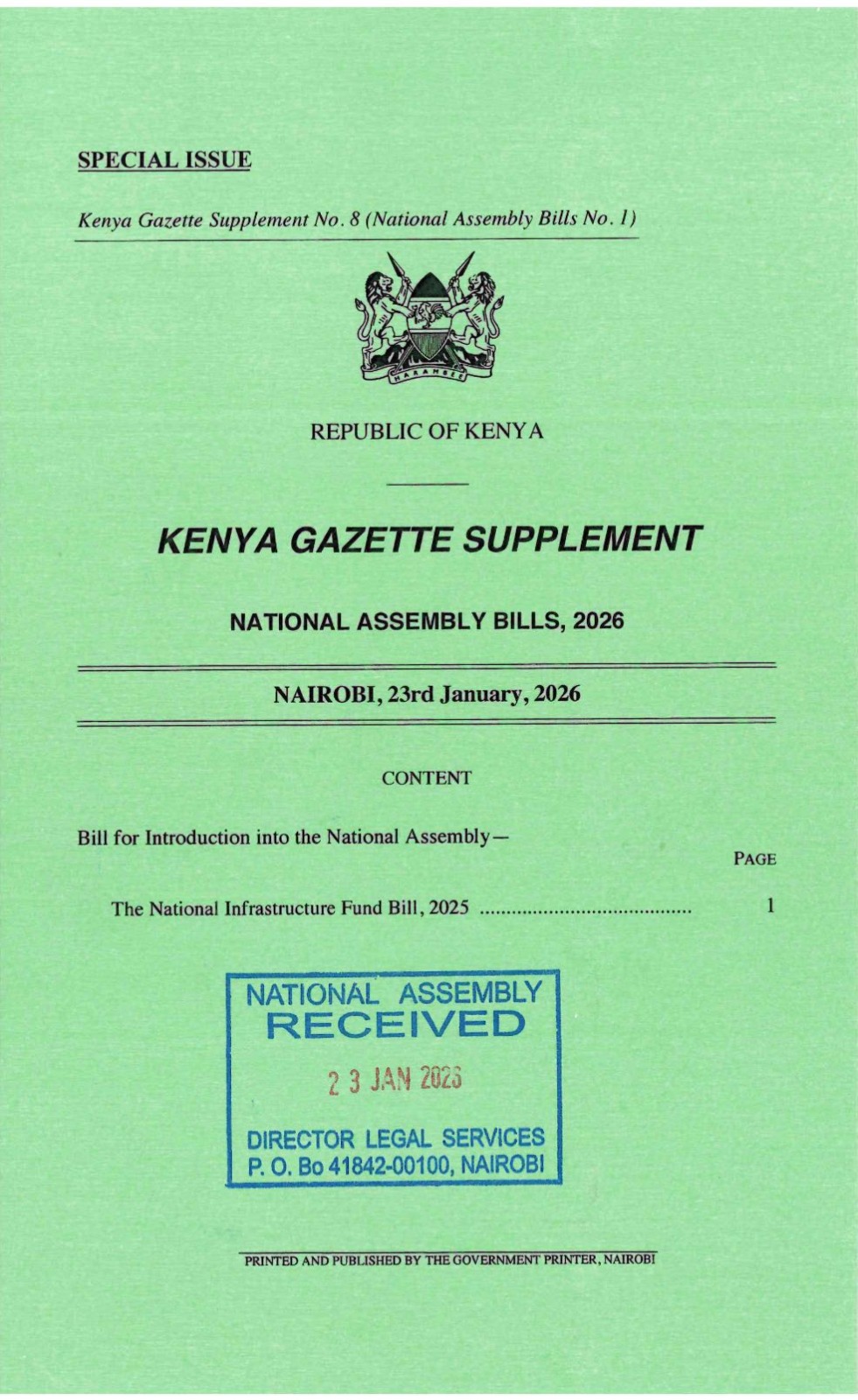
THE NATIONAL ASSEMBLY PASSES LANDMARK NATIONAL INFRASTRUCTURE FUND BILL, SETTING THE COUNRTY FOR TAKE OFF TO FIRST WORLD STATUS Friday February 6, 2026
The National Assembly on Thursday evening passed the National Infrastructure Fund Bill, 2026, marking a pivotal shift in how the country will finance and manage its most ambitious development projects.
Specifically, the Bill aims to mobilize nearly Ksh 5 trillion over the next decade to shift infrastructure financing from a debt-driven model to a sustainable, investment-led approach.
The proposed law seeks to establish the National Infrastructure Fund (NIF), which is expected to mobilise resources for key projects across sectors including transport, energy, water, irrigation and digital connectivity.
The Fund will also support development of highways, railways, ports, agribusiness infrastructure and other strategic national projects.
Unlike previous models which largely relied on borrowing to finance critical infrastructure development, the NIF is designed to attract investments from both public and private sectors.
After the robust debate in the Second Reading and the consideration of amendments at the Committee of the Whole House, the Leader of the Majority Party Hon. Kimani Ichungw’a thanked the House for supporting the Bill which he termed as the most consequential legislation ever passed by the House since Sessional Paper No.10 spearheaded by former Minister for Economic Planning Tom Mboya in 1965.
“Hon. Speaker should this Bill pass through the Third Reading stage, it will be the most consequential piece of legislation ever enacted by this House, not only in the 13th Parliament, but in the history of independent Kenya’s National Assembly”, he stated.
While acknowledging that a few Members of Parliament had opposed the Bill, he lauded the lawmakers for stating their case during the debate in the House. He further sought to allay fears over the Fund’s viability, and emphasized that the multi-trillion shilling fund was designed to propel Kenya toward first-world status.
The Bill had faced opposition from some Members who raised concerns about oversight and the potential for excessive Executive influence, specifically regarding the Treasury Cabinet Secretary.
However, amendments were included to strengthen parliamentary oversight of the Fund. The expanded role of Parliament in oversighting the Fund was among the key proposals made by stakeholders and members of the public during public engagements on the Bill.
To ensure the Fund's success, the Departmental Committee on Finance and National Planning, led by Hon. FCPA Kuria Kimani, introduced a series of safeguard amendments aimed at enhancing transparency, oversight, and professional management.
One of the most significant amendments is the establishment of a Governing Council. This high-level organ is designed to provide overall direction and counsel and act as an additional layer of protection for the Fund's assets. The Council will be composed of among others, the Cabinet Secretary for the National Treasury (Chairperson), the Governor of the Central Bank of Kenya and the Attorney-General. Six non-public officers with proven leadership in finance or public policy, appointed by the President for a three-year term will also join the team.The Council’s mandate includes overseeing the Investment Policy and recruiting the Board of Directors, though the law explicitly prevents it from controlling day-to-day operations to ensure the Board remains independent.
The House also moved to insulate the Fund from political interference by overhauling the Board of Directors. Under the new amendments, four independent directors must now be recruited through a competitive process by the Governing Council.
The Board members will be drawn from among professionals holders of degrees in fields such finance, engineering, or law and possess at least ten years of professional experience.
To institute integrity checks, a disqualification criteria were added, barring anyone currently serving on another state corporation board or those with specific criminal convictions.
Notably, the role of the CEO was expanded to include the Administrator of the Fund, to create a seamless, cost-effective reporting structure.
In a move to give Parliament more oversight power over the Fund’s management, the House approved a new mechanism for approving how the Fund will be appropriated . The Treasury Cabinet Secretary will now be required to submit the Fund’s Investment Policy to the National Assembly for approval. The House will have 90 days to approve, amend, or decline the policy.
Further, the House moved to include stringent punitive measures to deter the siphoning of funds.
“A person who misappropriates any funds... is liable to pay twice the amount misappropriated and faces a fine of at least ten million shillings or imprisonment for not less than five years," the new clause states.
While supporting this move, Hon. Kimani noted that the Bill had not provided for measures to deter errant officers from misappropriating the Fund, adding that the stringent penalties were justified to ensure the Fund is managed prudently.
“Hon. Speaker, I find these stringent punitive measures quite justified. If you do not want to be subjected to these penalties, do not attempt to misappropriate this Fund”, he cautioned.
While moving the Committee amendments, Hon. Kimani sought to clear up previous ambiguities, on the definition of ‘national infrastructure’. The Bill now provides a concrete definition of what the Fund will finance. This includes national highways, railway networks, airports, and seaports. In the Energy sector, the Fund is expected to facilitate electricity generation, transmission, and distribution.
The Fund will be anchored by diverse revenue streams, including proceeds from privatization and sales of government-linked corporation shares.
To avoid legal overlap, lawmakers deleted clauses that replicated the Public Private Partnership (PPP) Act, ensuring the Fund focuses on strategic commercial investment while leaving project preparation to the PPP Directorate. "The journey to Singapore has been crystallized," said Majority Leader Kimani Ichung’wah after the approval of the Bill. “We have now put the roadmap to the first world."
The Bill now awaits assent by President William Ruto.
Published by the National Assembly